Posts

Topics for final exam

The sheet of notes is still permitted. The topics for the final exam are: electrical charge proton, neutron, electron, quark - particles; which are fundamental and which are composite  atomic number and elements Coulomb's law charging things - what happens voltage current resistance units of V, I and R series circuit parallel circuit basics of circuits bulb brightness predictions - it's related to current (and series vs. parallel) V = I R basic electrical schematics (and symbols - battery, resistor, wire) magnetism electromagnetism electromagnetic induction compasses finding north magnetic north vs. geographic north
Electricity questions to submit before the final next week

1.  Why is it that electrons are the easiest particles to manipulate? 2.  What does atomic number (Hydrogen = 1, Helium = 2, etc.) mean? 3.  If two charged particles are pulled apart to 3 times their original distance of separation, how exactly will the force between them change? 4.  A 5-ohm resistor is connected to a 10-volt battery. What current goes through the resistor? 5.  Draw the symbols for battery, resistance and wire.  Draw a schematic for 2 resistors in series.  Draw a schematic for 2 resistors in parallel. 6.  What is strange about magnetic north on the Earth?

Magnetism, Electromagnetism, and EM Induction

Image
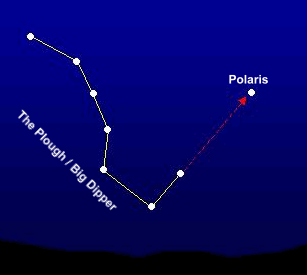
Magnetism! Similar to the case of charge, magnetic poles are divided into North and South poles. A North magnetic pole is one that points toward the Earth's magnetic north pole.  This means that the Earth's magnetic north is ACTUALLY A SOUTH POLE (magnetically speaking). Also: - Like poles repel - Opposite poles attract - Each magnet must have at least one North and one South pole (though they may have more than one of each).  There is NO such thing as a magnetic monopole. - Magnetic fields are real, but the lines are imaginary - Field lines indicate the direction that a compass needle would take in the vicinity of the magnetic field. - There are naturally occurring magnetic minerals - a very common one is called magnetite (Fe3 O4) Magnetic north on the Earth is near Ellesmere Island in Northern Canada, several hundred miles from true (geographic) North (the North Pole).  It is moving toward Russia at several miles per year. For gory detail: http://en.wikipedia.org/wiki...

Circuits 2

Image
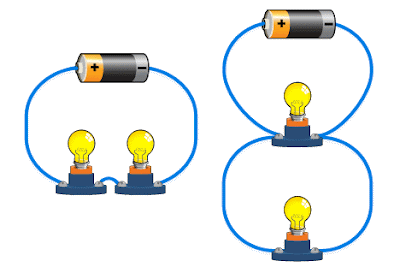
OK, so about regular circuits: The images represent SERIES CIRCUITS and PARALLEL CIRCUITS. In a  series  circuit, the current is  constant  and is set by the total resistance of the circuit (the sum of the resistors). If you remove one resistor (or light bulb, as in the first image), the current  stops . If the resistors were identical bulbs, having more bulbs would result in dimmer bulbs, since the battery voltage is distributed among them.  Note that the sum of the voltages "over" the bulbs is equal to the total voltage provided by the battery (give or take some minor losses).  Identical bulbs (or resistors) have identical voltages "over" them - 3 identical bulbs connected to a 9-V battery would have roughly 3-V each over them. In  parallel  circuits, current has multiple paths to take, so the total resistance of the circuit is actually LESS than if the resistors were alone or in series with other resistors - see details belo...

Circuits 1

Image
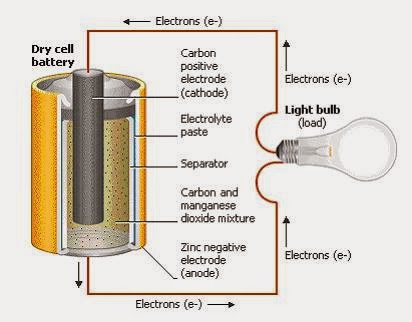
Thus far, we have only discussed "static" (stationary) charges.  Static charges alone are useful, but not nearly as much as charges in motion.  As you recall, electrons are the most easily moved particles.  However, for sake of ease in sign convention (positive vs. negative), we define the following: Current  (I) - the rate at which positive charge "flows" I = Q/t The unit is the coulomb per second, defined as an  ampere  (A).  Just as one coulomb is a huge amount of charge (nearly 6.3 billion billion protons), one ampere (or amp) is a tremendous amount of current - more than enough to kill a person.  In fact, you can feel as little as 0.01 A.  Typical currents in a circuit are on the order of mA (milliamperes). Essentially, current is how quickly charge travels (or charge per time, q/t).  The unit (a coulomb per second) is called the ampere (or amp, A).  To keep things simple, we think about positive charge moving, ...

Intro to electricity

Image
Intro to electricity Electricity I - Charge! Charge - as fundamental to electricity & magnetism as mass is to mechanics Charge is a concept used to quantatively related "particles" to other particles, in terms of how they affect each other - do they attract or repel?  If so, with what force? Charge is represented by letter Q. The basic idea - likes charges repel (- and -, or + and +) and opposite charges attract (+ and -). Charge is measured in units called coulombs (C).  A coulomb is a huge amount of charge, but a typical particle has a tiny amount of charge: - the charge of a proton is 1.6 x 10^-19 C.  Similarly, the charge of an electron is the same number, but negative, by definition (-1.6 x 10^-19 C).  The negative sign distinguishes particles from each other, in terms of whether or not they will attract or repel.  The actual sign is arbitrarily chosen. The charge of a neutron is 0 C, or neutral. But what IS charge? Charge is difficult to define. ...

Problems to submit (and practice for test)

Image
1.  Show how to compute the wavelength of the radio signal 107.9 MHz.  Note that MHz means 'million Hz." 2.  Concert A is defined as 440 Hz.  Find the following frequencies: a.  the next 2 A's that come after this one (one and two octaves above) b.  A#, which is one note immediately after concert A c.  the wavelength of a concert A note.  Assume that the speed of sound is 340 m/s. 3.  An ambulance siren has a 1000 Hz frequency.  Answer the following questions with:  greater than 1000 Hz, equal to 1000 Hz, less than 1000 Hz.  What frequency do the following people hear? a.  ambulance driver b.  person who the ambulance has passed c.  person who the ambulance is approaching d.  driver who is driving in the opposite direction of the ambulance, after the ambulance has passed 4.  What exactly causes refraction? 5.  Draw the rays that result from the Rays below: .

Lenses

Image
Lenses As shown and discussed in class, light refracts TOWARD a normal line (dotted line on the left image, perpendicular to surface of lens) when entering a more dense medium. Note in this  convex  lens that this direction of bend changes from down (with the top ray) to up with the bottom ray. This is due to the geometry of the lens. Look at the picture to make sure that this makes sense.  As a result, the rays will intersect after leaving the lens.  An image can form! The FOCAL LENGTH (f) of a lens (or curved mirror) where the light rays would intersect, but ONLY IF THEY WERE INITIALLY PARALLEL to each other. Otherwise, they intersect at some other point, or maybe not at all (if the object is too close to be focused on)! Note that your (human) eye lenses are convex - slightly thicker in the middle.  Thus, your eyes form "real" images on the retina - upside-down!  Unless, of course, the object is too close. If an image is projected onto ...

Light - Refraction

Image
Refraction : Consider a wave hitting a new medium - one in which is travels more slowly. This would be like light going from air into water. The light has a certain frequency (which is unchangeable, since its set by whatever atomic process causes it to be emitted). The wavelength has a certain amount set by the equation, c = f l, where l is the wavelength (Greek symbol, lambda). When the wave enters the new medium it is slowed - the speed becomes lower, but the frequency is fixed. Therefore, the wavelength becomes smaller (in a more dense medium). Note also that the wave becomes "bent." Look at the image above: in order for the wave front to stay together, part of the wave front is slowed before the remaining part of it hits the surface. This necessarily results in a bend. MORE DETAIL: The general rule - if a wave is going from a lower density medium to one of higher density, the wave is refracted TOWARD the normal (perpendicular to surface) line. ...

Exam 2 topics

Center of gravity - balanced torques (T = F L, on both sides of "lever"), what makes things stable  (C/G must be supported) Energy Waves - wavelength - frequency - speed - amplitude - crests and troughs wave speed = frequency x wavelength (Note that the wave speed is the speed of light when you are talking about electromagnetic waves.) mechanical vs. electromagnetic waves music - octaves (doubling the frequency); the next note on the piano (1.0594) Doppler effect - red shift, blue shift electromagnetic spectrum - radio, micro, IR, visible (ROYGBV), UV, X, gamma light reflection light refraction lenses and mirrors (convex and concave) focal length/point predicting light paths (when light is reflected or refracted)

Light Reflection

Image
Reflection - light "bouncing" off a reflective surface. This obeys a simple law, the law of reflection! The incident (incoming) angle equals the reflected angle. Angles are generally measured with respect to a "normal" line (line perpendicular to the surface). Note that this works for curved mirrors as well, though we must think of a the surface as a series of flat surfaces - in this way, we can see that the light can reflect in a different direction, depending on where it hits the surface of the curved mirror. So - light reflects from mirrors, according to the law of reflection.  However, if the mirrors is curved, light still obeys this rule - it just looks a bit different.  You have to visualize the curved mirror as a series of little flat mirrors. A convex mirror (top) acts reflects light rays "outward" - the light rays  seem  as though they are coming from inside the convex mirror, so it  seems  as though there is an image inside. ...

Light as a wave

Image
Recall that waves can be categorized into two major divisions: Mechanical waves, which require a medium. These include sound, water and waves on a (guitar, etc.) string Electromagnetic waves, which travel best where there is NO medium (vacuum), though they can typically travel through a medium as well. All electromagnetic waves can be represented on a chart, usually going from low frequency (radio waves) to high frequency (gamma rays). This translates to: long wavelength to short wavelength. All of these EM waves travel at the same speed in a vacuum: the speed of light (c). Thus, the standard wave velocity equation becomes: where v is the speed of light (3 x 10^8 m/s - usually represented in this case as c), Also, f is frequency (in Hz) and lambda is wavelength (in m). General breakdown of e/m waves from low frequency (and long wavelength) to high frequency (and short wavelength): Radio Microwave IR (infrared) Visible (ROYGBV) UV (ultraviol...

Update on Final Exam time

Hi there, Our final exam will be Wednesday, December 13 at 7:30 PM.  Normal class location.

Doppler!

The Doppler Effect http://www.lon-capa.org/~mmp/applist/doppler/d.htm http://falstad.com/mathphysics.html Run the Ripple tank applet - http://falstad.com/ripple/ The key in the Doppler effect is that motion makes the "detected" or "perceived" frequencies higher or lower. If the source is moving toward you, you detect/measure a higher frequency - this is called a BLUE SHIFT. If the source is moving away from you, you detect/measure a lower frequency - this is called a RED SHIFT. Distant galaxies in the universe are moving away from us, as determined by their red shifts. This indicates that the universe is indeed expanding (first shown by E. Hubble). The 2011 Nobel Prize in Physics went to local physicist Adam Riess (and 2 others) for the discovery of the accelerating expansion of the universe. Awesome stuff! http://www.nobelprize.org/nobel_prizes/physics/laureates/2011/ It's worth noting that the effect also works in reverse. If yo...

The sound of music

Image
Animation of sound as a mechanical wave: http://www.acs.psu.edu/drussell/Demos/waves/wavemotion.html Music In western music, we use an "equal tempered (or well tempered) scale."  It has a few noteworthy characteristics; The octave is defined as a doubling (or halving) of a frequency. You may have seen a keyboard before.  The notes are, beginning with C (the note immediately before the pair of black keys): C C# D D# E F F# G G# A A# B C (Yes, I could also say D-flat instead of C#, but I don't have a flat symbol on the keyboard.  And I don't want to split hairs over sharps and flats - it's not that important at the moment.) There are 13 notes here, but only 12 "jumps" to go from C to the next C above it (one octave higher).  Here's the problem.  If there are 12 jumps to get to a factor of 2 (in frequency), making an octave, how do you get from one note to the next note on the piano?  (This is ca...

Wave work

Try wave problems 1-5 in the first set below. And if time permits, play around with this: https://phet.colorado.edu/en/simulation/wave-on-a-string Wave problems 1 and 2, with answers Wave questions I 1.  Differentiate between mechanical and electromagnetic waves.  Give examples. 2.  Draw a wave and identify the primary parts (wavelength, crest, trough, amplitude). 3.  Find the speed of a 500 Hz wave with a wavelength of 0.25 m. 4.  What is the frequency of a wave that travels at 24 m/s, if 3 full waves fit in a 12-m space?  (Hint:  find the wavelength first.) 5.  Show how to compute the wavelength of WTMD's signal (89.7 MHz).  Note that MHz means 'million Hz."  Recall that radio waves travel at the speed of light. 6.  Middle C vibrates at 262 Hz (approximately).  Find the frequencies of the next 2 C's (1 and 2 octaves above this one). Answers: 1/2.  See notes 3.  v = f l = 500(0.25) = 125 m/s 4.  wavelength ...

What is energy?

Energy??? I stole my energy story from the famous American physicist Richard Feynman. Here is a version adapted from his original energy story. He used the character, "Dennis the Menace." The story below is paraphrased from the original Feynman lecture on physics (in the early 1960s). Dennis the Menace Adapted from Richard Feynman Imagine Dennis has 28 blocks, which are all the same. They are absolutely indestructible and cannot be divided into pieces. His mother puts him and his 28 blocks into a room at the beginning of the day. At the end of each day, being curious, she counts them and discovers a phenomenal law. No matter what he does with the blocks, there are always 28 remaining. This continues for some time until one day she only counts 27, but with a little searching she discovers one under a rug. She realizes she must be careful to look everywhere. One day later she can only find 26. She looks everywhere in the room, but cannot find them. Then she realises the window ...